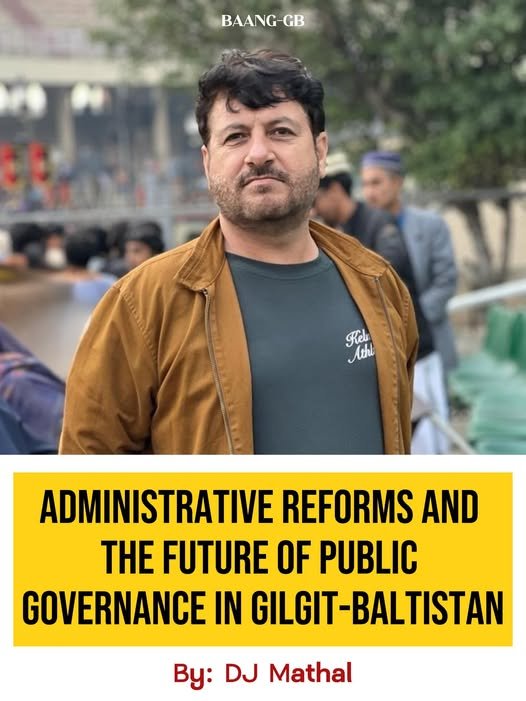
By: DJ Mathal
The relationship between the state and its people is not merely a constitutional or legal bond; it is an expression of trust, accountability, and public service upon which the progress of any society depends. When citizens entrust their elected representatives with power, their most fundamental expectation in return is that government institutions will address their problems in a timely, transparent, and effective manner. If discipline in public offices is weak, employees fail to observe punctuality, officials remain confined to their offices, and ordinary citizens are forced to make repeated visits to government departments for even routine matters, cracks begin to appear in the bond of trust between the state and the people. It is in this context that the recent surprise inspections of government departments by Gilgit-Baltistan Chief Minister Amjad Hussain Azar and his decision to open the doors of the Chief Minister’s Secretariat to the general public should be viewed.
Around the world, good governance is not built solely on major development projects; improvements in day-to-day administration are equally important. The success of any government is also measured by the level of respect, convenience, and timely justice it provides to citizens through its public offices. If government employees perform their duties with honesty, treat citizens with courtesy, and process every request within the prescribed timeframe, public confidence in the government naturally grows stronger. Conversely, when absenteeism, delays, favoritism, negligence, and a lack of seriousness become common in government offices, public trust begins to erode.
In this context, the Chief Minister’s surprise inspections of various government departments can be regarded as a significant administrative step. Such visits are not merely symbolic; their primary purpose is to convey that governance is not confined to paperwork and official files but is actively monitored in practice. When the head of the provincial government personally inspects offices, checks attendance registers, and orders action against absent employees, it sends a clear message throughout the public sector that negligence in the discharge of official duties can no longer be treated as routine.
Public complaints regarding government offices in Pakistan are nothing new. Citizens often complain that the concerned officer is not present in the office, staff fail to report on time, or they are made to move from one desk to another to complete even a simple task. These issues have fostered public frustration for decades. In such circumstances, if a provincial government places administrative discipline at the top of its priorities, it should be viewed not merely as a temporary measure but as the beginning of meaningful administrative reform.
However, it is also a reality that surprise inspections alone cannot bring about lasting change. They must be accompanied by a permanent monitoring system, transparent accountability, clearly defined performance indicators, and the use of modern technology. The biometric attendance system is one such measure. If every employee’s attendance and performance are properly recorded, if uniform action is taken against those who are absent, and if favoritism or external influence is eliminated, the overall performance of government institutions can improve significantly.
The Chief Minister’s emphasis that government employees are public servants reflects the fundamental spirit of democratic governance. A public office is not a symbol of authority or superiority; it is a responsibility to serve the people. Unless this principle becomes an integral part of the administrative system, even the best policies will fail to achieve their intended results. A courteous, responsible, and accountable public servant represents the positive face of the state, whereas an irresponsible official damages the reputation of the entire system.
In this context, the decision to open the doors of the Chief Minister’s Secretariat to the public is also of considerable significance. Pakistan’s bureaucracy has long faced criticism for keeping senior government offices beyond the reach of ordinary citizens. Because of security measures, official protocols, and administrative complexities, people often find it difficult to gain direct access to their elected representatives. If a government has made an effort to change this tradition, it can be regarded as a positive development, provided that the initiative is sustained on a permanent basis rather than remaining a temporary measure.
When individuals from different districts, remote areas, the business community, students, senior citizens, and other segments of society are able to meet the Chief Minister directly, it also enables the government to better understand the realities on the ground. Often, there is a clear gap between the figures contained in official files and the actual problems faced by people. Public meetings can serve as an effective means of bridging this gap. They not only provide citizens with an opportunity to voice their concerns but also allow the government to gain a clearer understanding of the nature of public issues and their priorities.
However, an important question also arises here: should the solution to every problem come only from the Chief Minister’s Office? Certainly not. A strong administrative system is one in which most issues are resolved at the district and departmental levels. If every application, complaint, and issue ultimately reaches the Chief Minister’s Office, it indicates that the intermediate administrative structure is failing to fulfill its responsibilities. Therefore, alongside public meetings, it is equally important to strengthen the capacity of district administrations, commissioners, deputy commissioners, and the relevant departments.
In a geographically challenging region such as Gilgit-Baltistan, the importance of effective public service becomes even greater. Residents of remote areas already face travel difficulties, harsh weather conditions, and limited resources. If they are required to make repeated visits to government offices for a single matter, their hardships increase significantly. In such circumstances, a system that ensures public accessibility and prompt decision-making not only saves time but also restores public confidence.
The true test of any government lies not in its announcements but in their implementation. If action against absent employees is genuinely taken without discrimination, if punctuality in government offices is consistently enforced, if public complaints are resolved within the prescribed timeframe, and if public meetings at the Chief Minister’s Secretariat continue on a regular basis, these measures can lay the foundation for a positive transformation in Gilgit-Baltistan’s administrative history. However, if after a few weeks these activities are reduced to mere formalities, public expectations may once again turn into disappointment.
Successful countries around the world have demonstrated that strong institutions do not depend on a single individual; rather, they function under laws and systems that remain consistently effective regardless of which government is in power. It is therefore essential that the current initiatives evolve beyond individuals and become part of lasting institutional reforms. The biometric attendance system, an effective online complaint mechanism, annual performance evaluations, public feedback, and transparent accountability should all become permanent elements of government policy so that these standards continue to be maintained in the future.
At the same time, attention must also be given to the training, professional development, and motivation of government employees. A system based solely on punishment does not produce lasting results. Employees who demonstrate outstanding performance should also be rewarded through recognition, promotions, and incentives. When both accountability and recognition are balanced, they create an environment of healthy competition within public institutions.
The public also has a responsibility not to limit itself to criticism but to play an active role in positive change. Along with raising complaints, citizens should offer constructive suggestions, respect the rule of law, and treat public property and resources as a national trust. A strong state is built not only through government initiatives but through the shared responsibilities of both the government and its citizens.
Gilgit-Baltistan, with its natural beauty, tourism potential, and strategic significance, is a region of immense importance. Effective, transparent, and people-centered governance can not only improve the quality of life of its residents but also open new opportunities for investment, tourism, and economic growth. If the current process of administrative reform continues with consistency, transparency, and impartiality, its positive impact will extend far beyond government offices and help establish a new culture of rule of law, responsibility, and public trust throughout society.
Ultimately, the true identity of any government is defined not by its slogans but by its actions. Accessible leadership, well-organized public institutions, accountable employees, and the timely delivery of public services are the real benchmarks of good governance. If these initiatives in Gilgit-Baltistan continue with consistency, transparency, and institutional reform, they could become a model not only for the province but for other parts of the country as well. The journey toward public service will truly succeed only when every door of the state is open to the people, every office is punctual, every official is accountable, and every decision is guided by the public interest.